Artists
“It took me four years to paint like Raphael, but a lifetime to paint like a child.”
- Pablo Picasso
 Kaede
It is striking to see a person drawing for the first time approach such a complex subject with confidence and precision. The castle is rendered with a structural clarity that reveals not only technical observation but also a natural grasp of perspective and spatial order.
The gentle tonality of the watercolor lends the scene a quiet elegance, while the medium’s fluid character echoes the transience of drifting clouds and shifting light. This sensitivity to atmosphere enriches the work beyond its architectural accuracy.
 Weitong
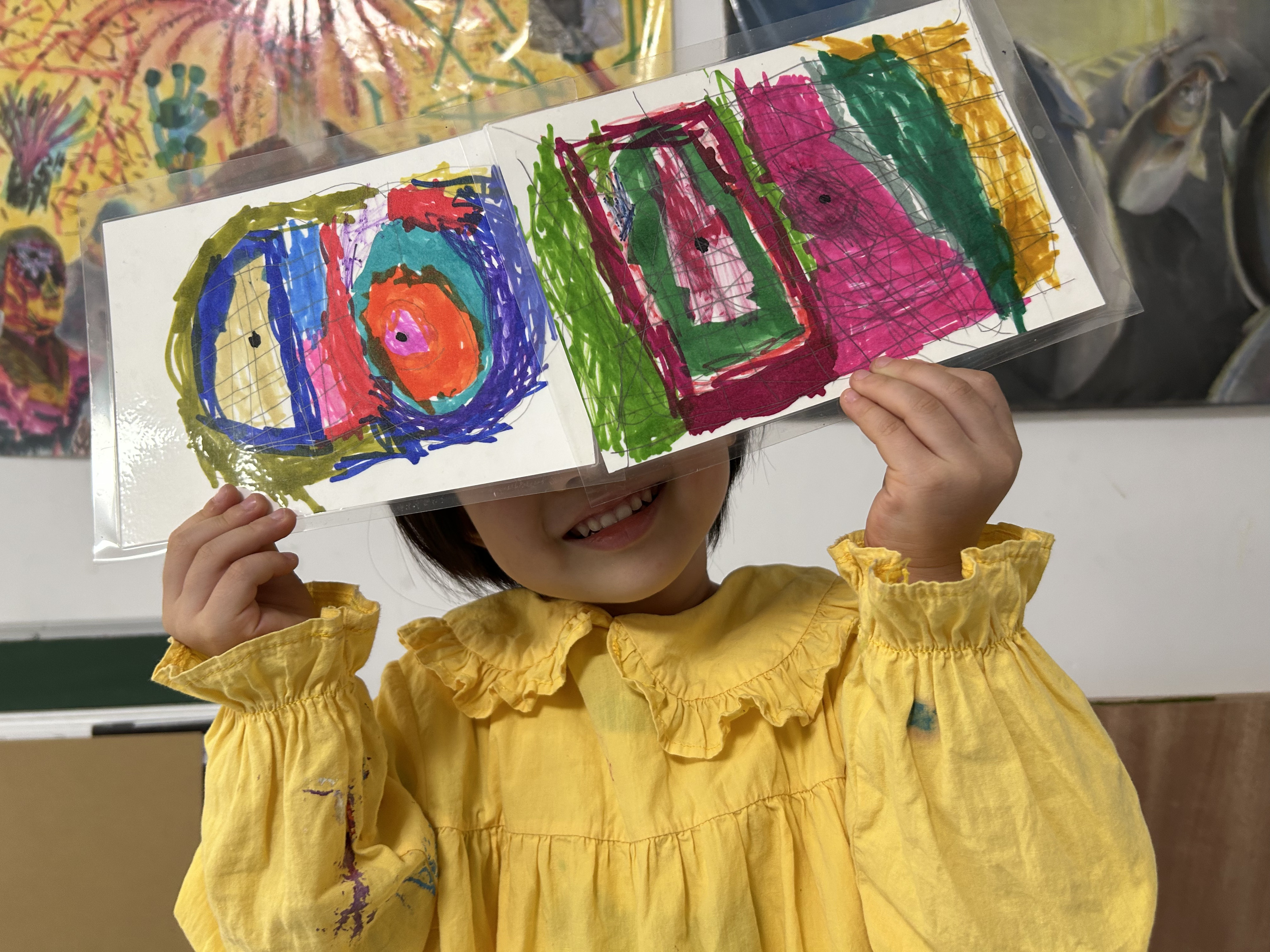
How astonishing can the color intuition of a four-year-old be?
That was my reaction when I first encountered Weitong’s work. She seems to possess an innate grasp of harmonious combinations, especially in her use of complementary pairs: purple with yellow, red with green. I cannot tell whether this arises from natural instinct or from the guidance of early art education.
Beyond the surprise of her color choices, what captivated me were the floating symbols she traced with acrylic markers—symbols only she herself can fully understand. Layered over the dense, weighty background of acrylic paint, this thinner veil of imagery works in concert with it, creating a rich sense of depth and charging the work with an immediacy and contemporary resonance far beyond her years.
 Yuchen
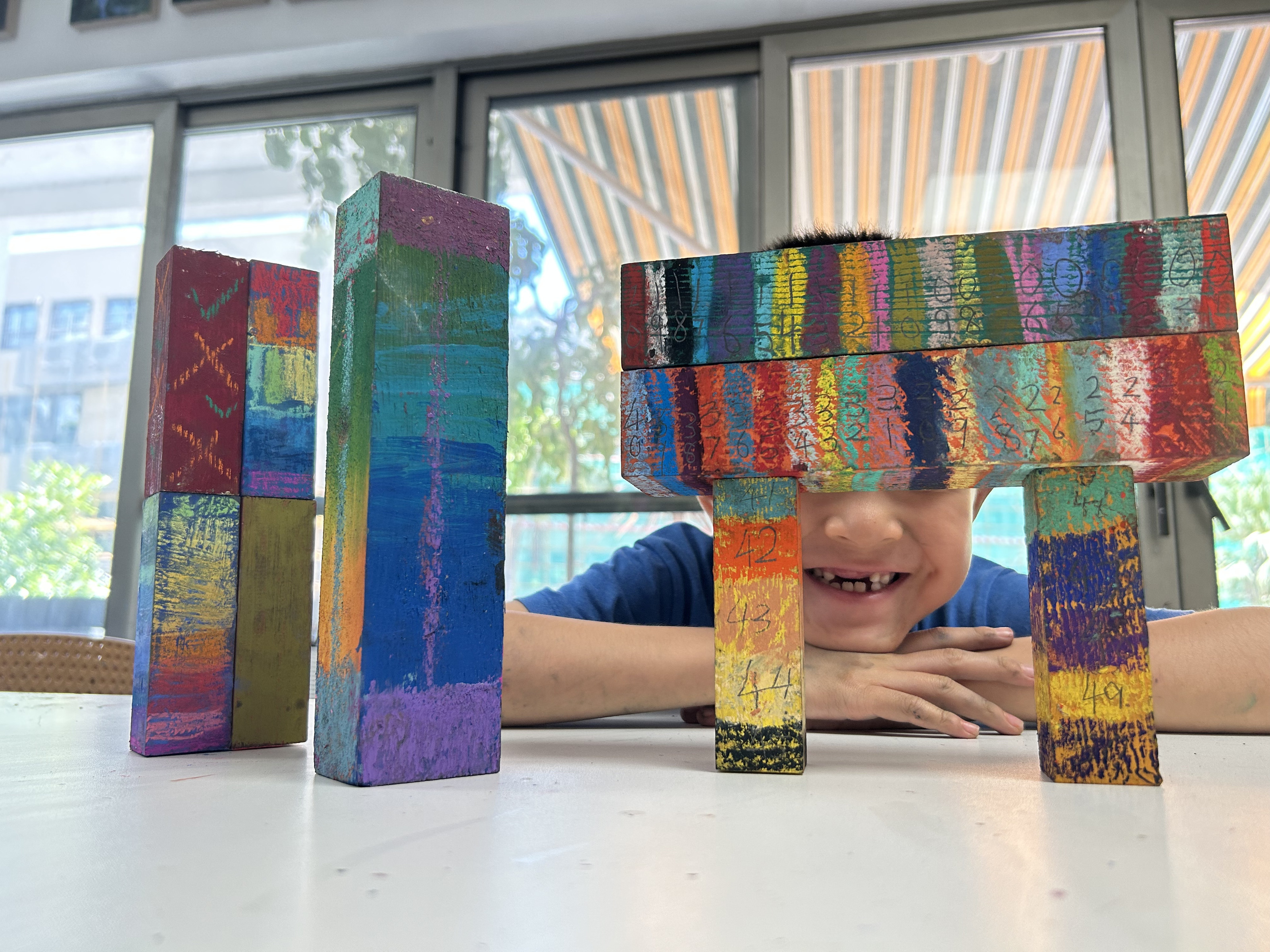
The combination of mathematical symbols with the soft, low-saturation “Morandi palette” creates something quietly miraculous. Pastel tones create a scene I could only imagine in the cosy, warm light of a Nordic home, yet here the colours are far more unexpected—impossible to pin down with words. They do not follow the logic of complementary contrast; instead, they feel as though they were always meant to be there. This is not something one could simply learn.
Though subdued in tone, these works still remind me of the vibrant rhythm of Piet Mondrian’s modern masterpiece Broadway Boogie Woogie—but without its forceful intensity, expressed instead in a gentler register. Their modernity and subtle hues also call to mind the work of British artist Christopher Le Brun, which I was fortunate to encounter at an exhibition in Shenzhen a few years ago.
The geometric forms and numerical symbols enrich and heighten the muted palette, bringing to mind the phrase “mathematical orchestra.” In Mathematical Orchestra No. 1, the layering of numbers across the soft blocks of colour resonates with the floating planes in Weitong’s paintings. Perhaps this instinct to inscribe, to leave marks—whether words, numbers, or symbols—is something all children share, carried here into a strikingly mature visual language.
 Ziwen
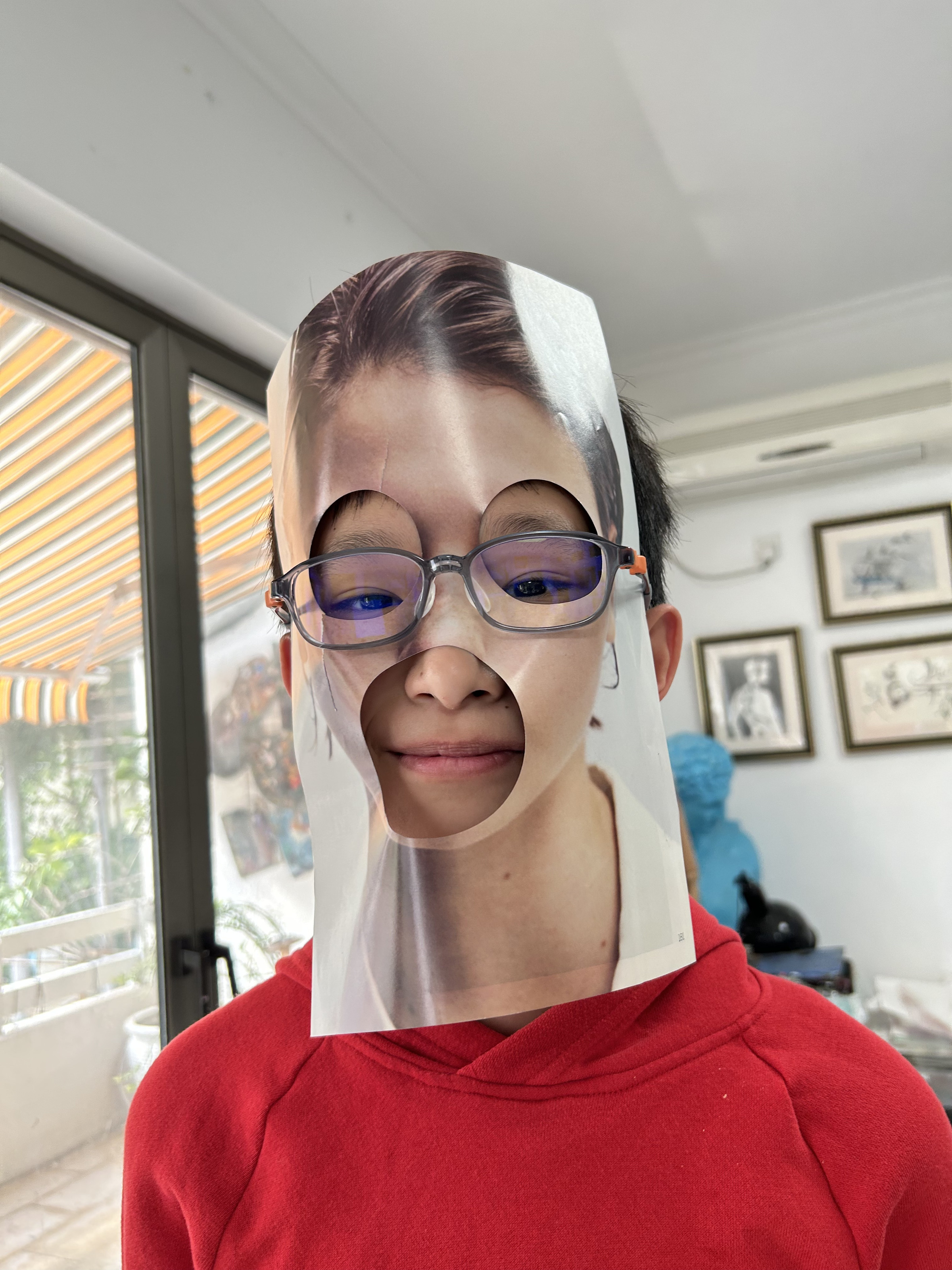
My first impression watching Ziwen paint was of a patience far beyond his years. In colouring, he proceeds stroke by stroke—clean, deliberate, filling each area meticulously in a way that feels worlds away from the usual childhood scrawl. It astonished me—nothing like my own childhood habit of scribbling in circles.
This suite of sketches feels remarkably resolved, and the relationship between the figures and their space is unusually mature and harmonious. In Life Study No. 1, the figure enters a quiet dialogue with the poster behind, the two holding each other in balanced tension; in Confronting Myself No. 3, a quietly voyeuristic, unexpected vantage point emerges, as if the image were observing itself.
Ziwen’s use of colour is bold yet restrained; reserves of blank space act as light and air, giving the image room to breathe and tightening its tensile energy. Pink appears in just the right proportion—neither cloying nor saccharine, yet still vibrant—imbuing the work with a playful, impish humour that signals youth even as the overall sensibility reads as strikingly mature.