Yuchen
Location
Shenzhen, China
Age
7
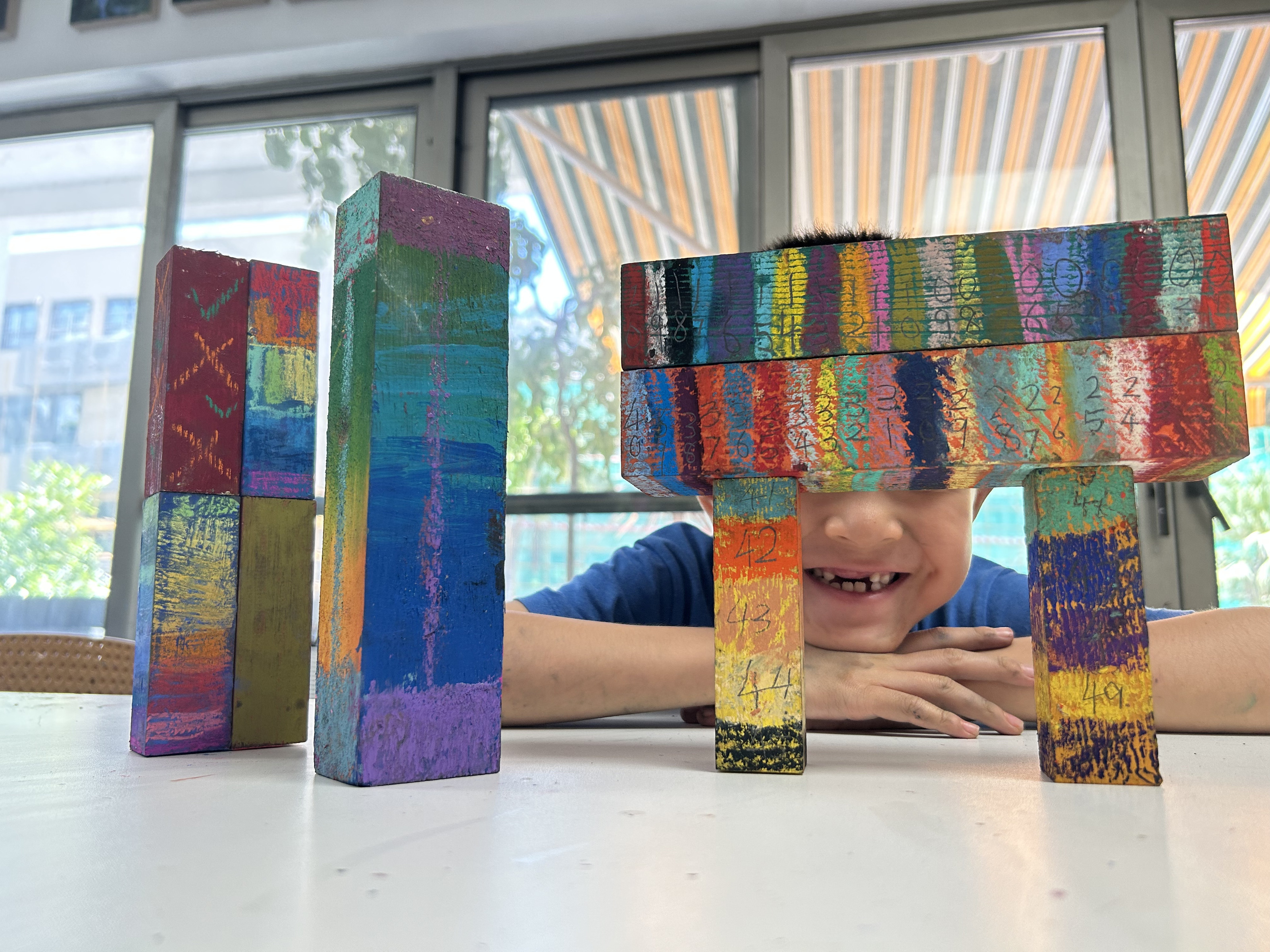
The combination of mathematical symbols with the soft, low-saturation “Morandi palette” creates something quietly miraculous. Pastel tones create a scene I could only imagine in the cosy, warm light of a Nordic home, yet here the colours are far more unexpected—impossible to pin down with words. They do not follow the logic of complementary contrast; instead, they feel as though they were always meant to be there. This is not something one could simply learn.
Though subdued in tone, these works still remind me of the vibrant rhythm of Piet Mondrian’s modern masterpiece Broadway Boogie Woogie—but without its forceful intensity, expressed instead in a gentler register. Their modernity and subtle hues also call to mind the work of British artist Christopher Le Brun, which I was fortunate to encounter at an exhibition in Shenzhen a few years ago.
The geometric forms and numerical symbols enrich and heighten the muted palette, bringing to mind the phrase “mathematical orchestra.” In Mathematical Orchestra No. 1, the layering of numbers across the soft blocks of colour resonates with the floating planes in Weitong’s paintings. Perhaps this instinct to inscribe, to leave marks—whether words, numbers, or symbols—is something all children share, carried here into a strikingly mature visual language.